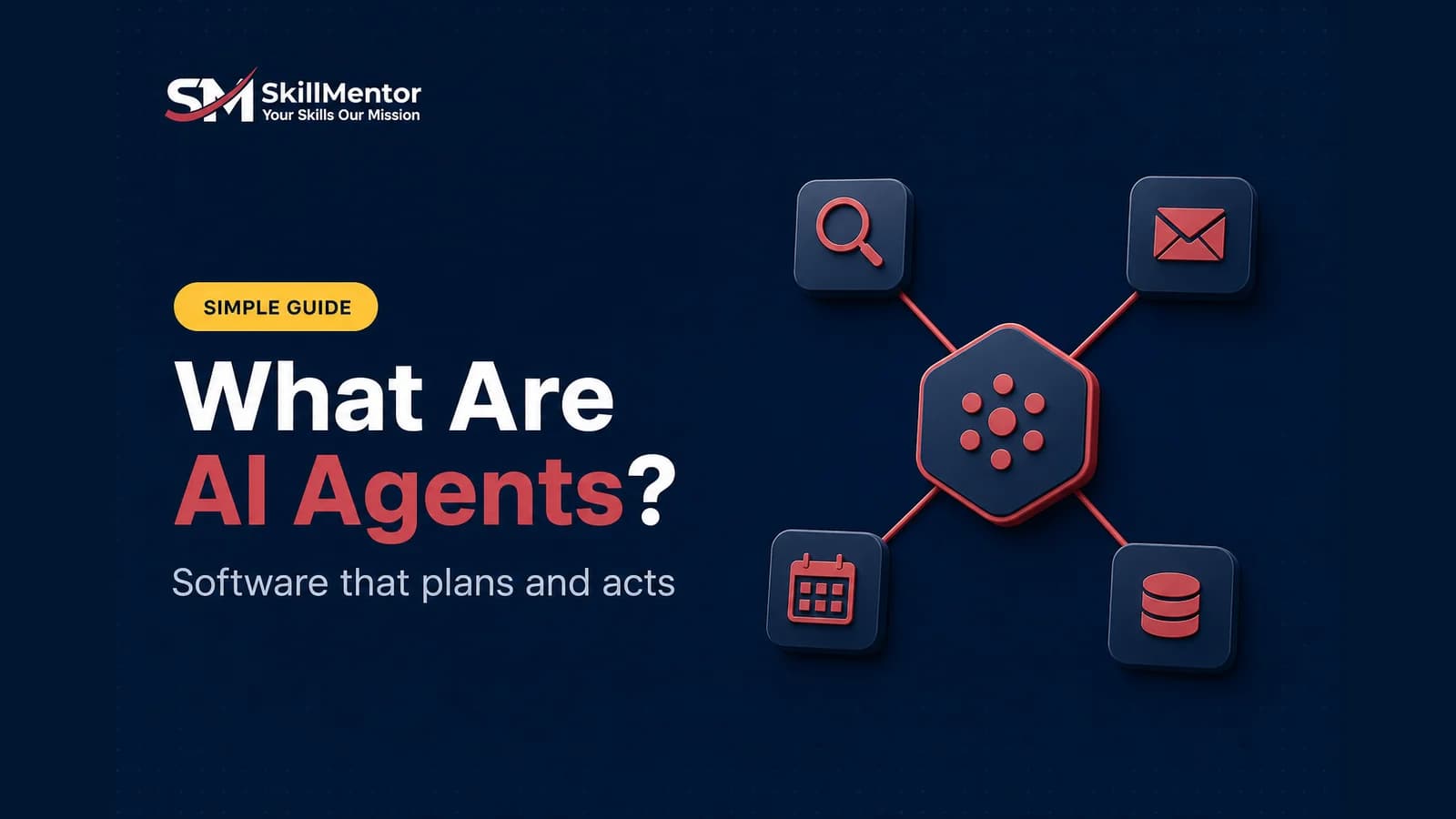
An AI agent is software that uses an AI model to work towards a goal by itself: it decides what steps to take, uses tools to carry them out, looks at the results, and keeps going until the job is done. A chatbot answers a question. An agent is given a task – “find out why this order failed and email the customer” – and works out how to do it.
This guide explains what agents are, how they differ from ordinary automation, what they are made of, where they go wrong, and what people in Pakistan are building with them.
AI agent vs chatbot vs automation
- Chatbot – you ask, it answers. It does not take action in other systems.
- Automation (a workflow) – a fixed set of steps that a person designed in advance. “When a form is submitted, add a row to the sheet and send an email.” It does the same thing every time.
- AI agent – the AI model itself decides which steps to take and which tools to use, based on the situation in front of it.
Anthropic, the company behind Claude, draws the same line in its guide Building Effective Agents: workflows follow paths that were written in advance, while agents direct their own process and tool use.
What an AI agent is made of
- An AI model – the “brain” that reads the situation and decides what to do next.
- Tools – the things it is allowed to do: search the web, read a database, send a message, create a calendar event, run code.
- Knowledge – documents or data it can look things up in, such as a company’s policies or product list.
- Memory – what it has already done in this task, so it does not go round in circles.
- A goal and limits – what it is trying to achieve, and what it must never do without asking a human.
Real examples
- Customer support agent. Reads a WhatsApp message, checks the order system, answers from the company’s own policies, and hands over to a person when it is unsure.
- Lead research agent. Takes a company name, looks it up, summarises what it does, and drafts a personalised first message for the sales team.
- Coding agents. Tools such as Claude Code, Cursor and Google Antigravity are agents: you describe a feature and they edit files, run the app and fix what breaks.
- Reporting agent. Collects numbers from several systems every Monday, notices what changed, and writes the summary.
When you should NOT use an agent
This is the part most articles skip. Agents are slower and more expensive than simple automation, because the AI model is called many times while it thinks and acts. Anthropic’s guide says plainly that agents trade speed and cost for better performance on hard tasks, and recommends starting with the simplest thing that works.
If the steps are always the same, build a normal workflow. It will be cheaper, faster and more reliable. Use an agent only when the task genuinely changes from case to case and you cannot write the steps down in advance.
Where agents go wrong
- Errors build on each other. One wrong decision early on leads to more wrong steps after it.
- They can take real actions. An agent that can send emails or change records can also send the wrong email or change the wrong record.
- Costs can surprise you. A task that loops many times uses a lot of paid AI calls.
The fixes are practical: give the agent only the tools it needs, require human approval for anything risky, test it in a safe environment before letting it near real customers, and set limits on how many steps it may take.
How agents are built
You do not need to be a programmer to build a useful agent. Visual automation tools now include agent features – in n8n, for example, you place an AI agent on the canvas, connect the tools it may use, and give it instructions. Developers who want more control write agents in code instead. Either way, the hard part is not the tool. It is understanding the business process well enough to decide what the agent should and should not be allowed to do.
Frequently Asked Questions
What is an AI agent in simple words?
An AI agent is software that is given a goal and works out the steps by itself. It uses an AI model to decide what to do, uses tools to do it, checks the result and continues until the task is complete.
What is the difference between an AI agent and a chatbot?
A chatbot answers questions. An AI agent takes actions – it can look things up, update systems and send messages to complete a task.
What is the difference between an AI agent and automation?
Automation follows fixed steps that a person designed in advance. An AI agent decides its own steps based on the situation. Automation is cheaper and more reliable for predictable work; agents suit tasks that change each time.
Is ChatGPT an AI agent?
Used as a simple chat, no – it only answers. When an AI model is connected to tools and allowed to carry out multi-step tasks by itself, it is working as an agent.
Can I build AI agents without coding?
Yes. Visual tools such as n8n let you build agents by connecting blocks. Understanding APIs and a little code helps as projects become more advanced.
Can I earn from building AI agents in Pakistan?
Yes. Businesses pay for agents that handle customer support, lead research and reporting. The value is in connecting the AI to the company’s real systems safely, which is a skill most people do not yet have.
The bottom line
An AI agent is an AI model that can decide and act, not just answer. Agents are powerful for tasks that vary from case to case – and the wrong choice for simple, repeated work, where ordinary automation is cheaper and safer. Knowing the difference is what makes someone valuable.
Building agents is part of our eight-week AI Automation course – including a full week on AI agents, chatbots and APIs in n8n, and another on the MCP protocol for connecting AI models to real tools. PKR 15,000 live online, or on campus in Lahore. Take the free course quiz to see if it fits you.
Recommended For You
Ready to Master These Skills?
AI Automation Training Program
Build intelligent workflows with N8N, Make.com & Zapier. Connect apps, eliminate repetitive tasks, and deploy self-running AI agents.
Vibe Coding
Build full-stack apps with AI tools like Cursor and Replit. Write software using natural language and deploy real applications.